“Those who ask questions, lead.” This idea, shared by former Continental manager and leadership expert Harald Schirmer in a recent podcast, particularly resonated with us. Behind it lies a simple but important insight: leadership does not mean having all the answers. Good leadership also means remaining curious, questioning what we already know, and continuing to learn. For us at PMI, this idea has a very specific meaning. It reflects something we have observed for many years in the education and development of Supply Chain professionals.
Supply Chain Management needs a common language
Supply Chain Management today is about much more than optimizing individual functions. Demand Planning influences production and inventory. Procurement decisions affect cost, resilience and sustainability. Inventory strategies influence working capital and service levels. Sales decisions change forecasts and capacity requirements – and ultimately impact the entire Supply Chain. At the same time, organizations face new challenges: digitalization, artificial intelligence, geopolitical risks, sustainability, circular economy and the growing need to build more resilient Supply Chains. The most important questions can therefore rarely be answered within a single function.
This makes a common Supply Chain language increasingly important. Terminology, interdependencies and objectives need to be understood across functional boundaries. Procurement, Planning, Manufacturing, Logistics, Sales and Management do not necessarily need to share the same perspective – but they should understand how their decisions affect one another. And this is where many Supply Chain transformations face one of their greatest challenges.
A common language cannot simply be mandated
Organizations invest heavily in education and capability development. Employees attend training programs, earn certifications and learn new methods and frameworks. But what happens when leadership itself is not part of this learning journey? A gap can quickly emerge. Employees may learn about modern planning approaches, end-to-end thinking or new Supply Chain Management concepts, only to return to decision-making structures, targets and management language that remain strongly functionally oriented.
A common Supply Chain language, however, cannot simply be mandated. Leaders need to speak it themselves. This does not mean that every executive has to become a Supply Chain expert. It means understanding the fundamental interdependencies, being able to put new developments into context, and being willing to continuously broaden one's own perspective.
Making learning a visible part of leadership
Learning becomes particularly powerful when leaders actively participate. When a CEO, senior manager or Supply Chain Director learns alongside others, asks questions and openly discusses different perspectives, it sends a much stronger message than any request for employees to participate in training: Learning matters – for me, too.
The impact of this role modelling should not be underestimated. Leaders who visibly remain curious create an environment in which questions are encouraged. They demonstrate that learning does not end with a job title or management position. And through their own motivation, they can encourage their people to continue learning as well. This is how individual development can gradually contribute to building a learning organization.
Supply Chain Excellence is a team sport
This is particularly important in Supply Chain Management. Supply Chain performance is never created by one department alone. It is the result of many interconnected decisions. An excellent Demand Planner alone does not create an excellent Supply Chain. Neither can Procurement, Manufacturing or Logistics achieve Supply Chain Excellence in isolation. What matters is how these functions work together.
For this reason, modern Supply Chain education should not only be about acquiring functional knowledge. It should also help people understand the consequences their decisions have for other parts of the organization. What happens to inventory when Sales changes its forecast? How does a sourcing decision affect manufacturing flexibility or working capital? How do service-level targets influence capacity, inventory and cost? Once people understand these interdependencies, discussions change – and very often, decisions change as well.
Standards create orientation
A common language also needs a common frame of reference. International standards and established Supply Chain frameworks can play an important role here. They create a shared understanding of processes, terminology, metrics and interdependencies. For us, this has always been one of the key strengths of APICS and ASCM education.
Programs such as CPIM, CSCP, CLTD and CTSC do more than prepare professionals for an exam or certification. When used effectively, they establish a common frame of reference that enables Supply Chain professionals from different functions, companies and countries to communicate and collaborate more effectively. This supports collaboration within an organization while also making different experiences easier to compare – creating a foundation for new ideas and perspectives.
Why face-to-face learning still matters
Digital learning has made professional development more flexible and accessible and has become an essential part of today's learning landscape. Yet we continue to see the unique value of face-to-face training. Because learning does not happen only through course materials, models or presentations. It also happens during the breaks.
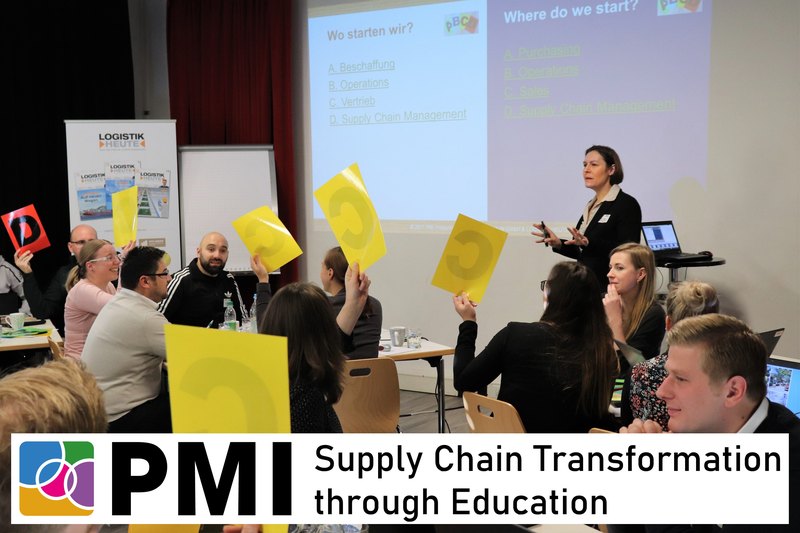
Over coffee after an interesting discussion. When participants compare challenges from different companies. When one question suddenly opens an entirely new perspective. Or when someone explains how a concept has actually been implemented in their organization. Experienced Supply Chain professionals bring an enormous amount of knowledge and practical experience into a classroom. When these experiences are shared, participants learn not only from the instructor but also from one another. This is why we see face-to-face training as both a learning and networking opportunity.
Learning together in Munich this November
In November, PMI will once again offer face-to-face Supply Chain training in Munich. These courses provide an opportunity to deepen or refresh Supply Chain knowledge, challenge established ways of thinking and exchange ideas and experiences with other Supply Chain professionals.
And perhaps this is particularly valuable for leaders. Not entering a classroom because you do not know enough. But entering it because you understand that learning is never finished. Leaders who expect curiosity, adaptability and continuous learning from their organizations can provide the strongest possible example by demonstrating these qualities themselves.
Those who ask, learn. Those who learn, evolve.
Supply Chains will not become less complex in the years ahead. New technologies, sustainability requirements, geopolitical developments and changing customer expectations will continue to present organizations with new questions. An organization's ability to respond will therefore not depend solely on how much it knows today. It will also depend on how well it can continue to learn tomorrow.
That requires expertise. It requires common standards. It requires exchange and professional networks. Most importantly, it requires people – and leaders – who remain curious.
Because a common Supply Chain language cannot simply be mandated. Leaders need to speak it themselves.