Measuring the immeasurable?
In many companies, Sales & Operations Planning (S&OP) is a central steering mechanism of the supply chain. But as central as it is, measuring it remains a challenge. While KPIs in logistics or procurement are often clear, S&OP quickly reaches methodological and cultural limits.
Why are S&OP KPIs controversial?
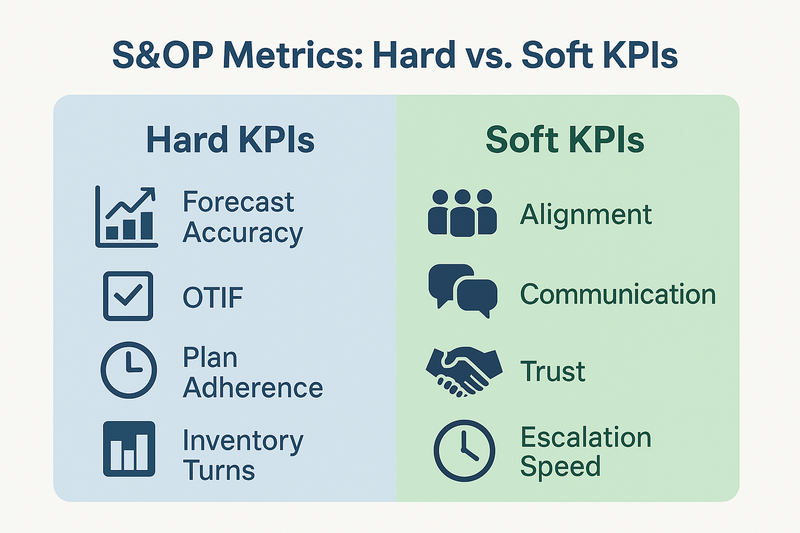
Common metrics such as
- Forecast Accuracy
- Plan Adherence
- Inventory Turns
- OTIF (On Time In Full)
are useful, but they only highlight partial aspects. They do not show whether functions are truly aligned. They say nothing about trust, decision quality, or escalation behavior.
Hard KPIs also often lead to tactical behavior: forecasts are deliberately conservative to simulate accuracy. Adherence is reported even when the plan is already outdated.
The misconception: treating S&OP as a reporting process.
S&OP is, above all, a learning process. It is about planning together under uncertainty, preparing for scenarios, and making decisions transparent. That requires continuous learning – not just data analysis.
What does this mean for practice?
- Challenge KPIs regularly: Not every metric stays relevant over time.
- Foster a learning culture instead of KPI pressure: Open discussions about forecast errors or deviations strengthen the process.
- Integrate soft KPIs: Workshop effectiveness, communication efficiency, or escalation timing can also be measured.
Conclusion:
S&OP is driven by people, not numbers. The right metrics can provide orientation – but only if they reflect the reality of collaboration.
Long-term planning requires long-term learning – about S&OP, about teams, and about the limits of metrics.
In our training programs, we teach how to set up S&OP strategically, integrate it with S&OE, and incorporate MPS – for a resilient, responsive supply chain. You can find suitable courses here: